Hubble сфотографировал медузообразную галактику в созвездии Кита (ФОТО)
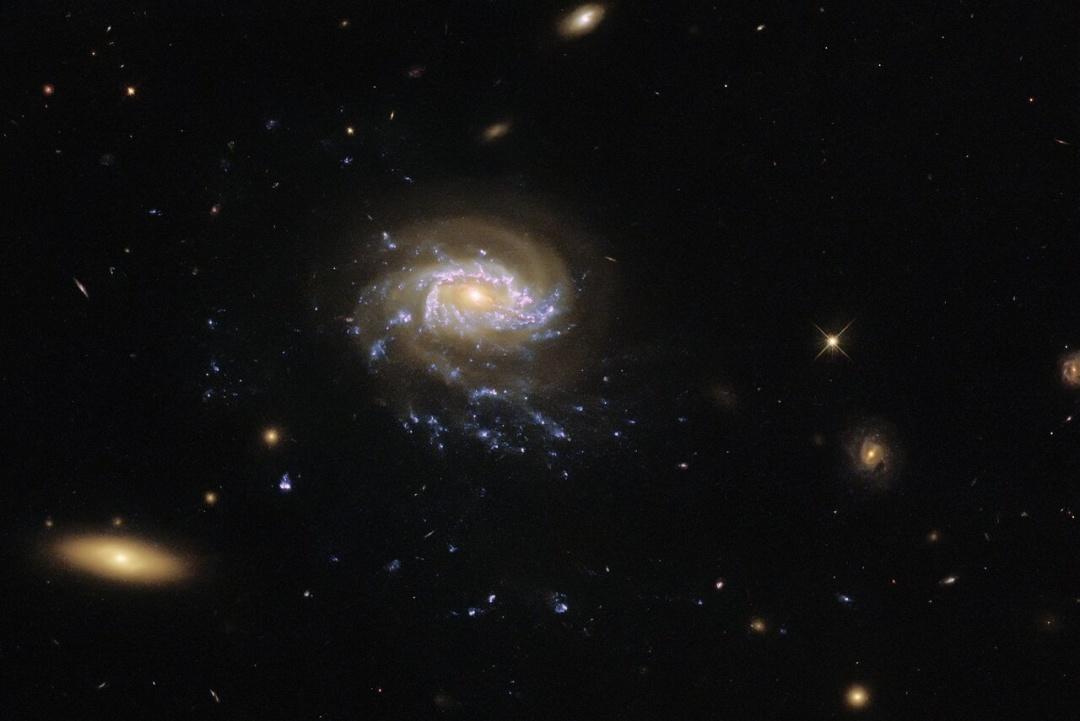 A jellyfish galaxy with trailing tentacles of stars hangs in inky blackness in this image from the NASA/ESA Hubble Space Telescope. As Jellyfish galaxies move through intergalactic space they are slowly stripped of gas, which trails behind the galaxy in tendrils illuminated by clumps of star formation. These blue tendrils are visible drifting below the core of this galaxy, and give it its jellyfish-like appearance. This particular jellyfish galaxy — known as JO201 — lies in the constellation Cetus, which is named after a sea monster from ancient Greek mythology. This sea-monster-themed constellation adds to the nautical theme of this image. The tendrils of jellyfish galaxies extend beyond the bright disc of the galaxy core. This particular observation comes from an investigation into the sizes, masses and ages of the clumps of star formation in the tendrils of jellyfish galaxies. Astronomers hope that this will provide a breakthrough in understanding the connection between ram-pressure stripping — the process that creates the tendrils of jellyfish galaxies — and star formation. This galactic seascape was captured by Wide Field Camera 3 (WFC3), a versatile instrument that captures images at ultraviolet and visible wavelengths. WFC3 is the source of some of Hubble’s most spectacular images, from a view of Jupiter and Europa to a revisit to the Pillars of Creation. [Image description: A spiral galaxy lies just off-centre. It has large, faint, reddish spiral arms and a bright, reddish core. These lie over two brighter blue spiral arms. These are patchy, with blotches of star formation. Long trails of these bright blotches trail down from the lower spiral arm, resembling tendrils. The background is black, lightly scattered with small galaxies and stars, and a larger elliptical galaxy in one corner.] Links First science paper in the Astrophysical Journal Second science paper in the Astrophysical Journal
Космический телескоп NASA/ESA Hubble сфотографировал на камеру Wide Field Camera 3 (WFC3) медузообразную галактику JO201 в созвездии Кита.
Об этом сообщила обсерватория.
Медузообразные галактики наблюдаются в скоплениях и возникают под действием лобового давления газа. Давление выдувает газ в межгалактическую среду, вызывая вспышки звездообразования вдоль газового хвоста. Впоследствии во всех таких галактиках заканчивается газ, и звездообразование прекращается.
Следовательно, медузообразные галактики в скоплении скорее перестают образовывать новые звезды, чем соседние галактики.
На фотографии, сделанной телескопом, видно, что «щупальца» этих медузообразных галактик выходят за пределы яркого диска ядра галактики. Это наблюдение видно из исследования размеров, масс и возраста сгустков звездообразования.
Астрономы надеются, что такие наблюдения обеспечат прорыв в понимании связи между сбросом давления тарана — процессом, создающим «щупальца» этих галактик — и образованием звезд.
WFC3 является универсальным инструментом, который фиксирует изображение в ультрафиолетовом и видимом диапазонах.
Поддерживайте «Громадське радио» на Patreon, а также устанавливайте наше приложение:
если у вас Android
если у вас iOS