Ukrainians are fighting also our war, — Ambassador of Estonia to Ukraine Tiina Intelmann
 Andriy Kulykov
 Olena Rebryk
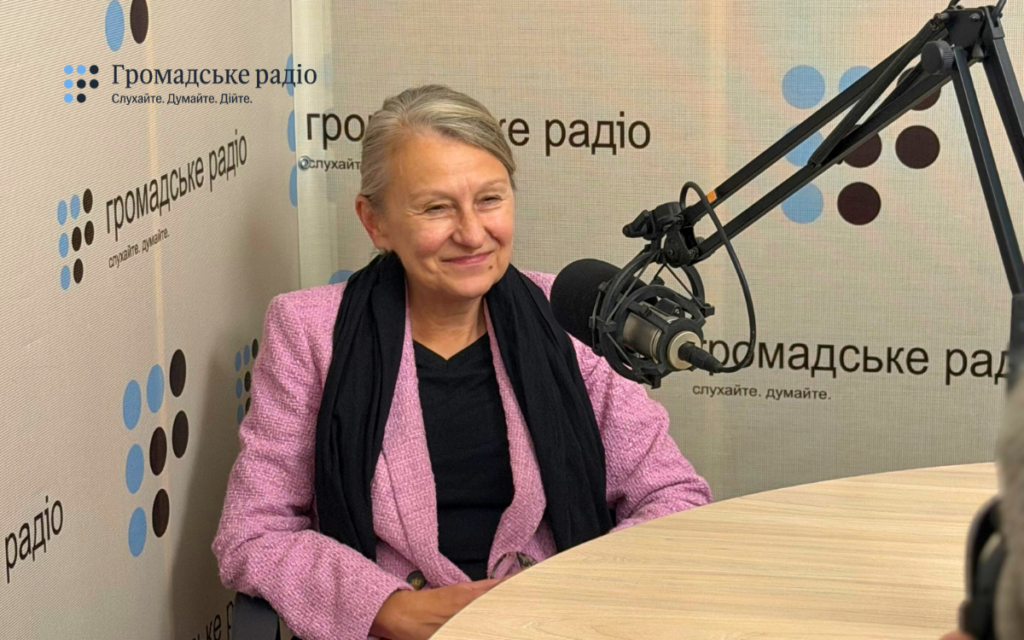
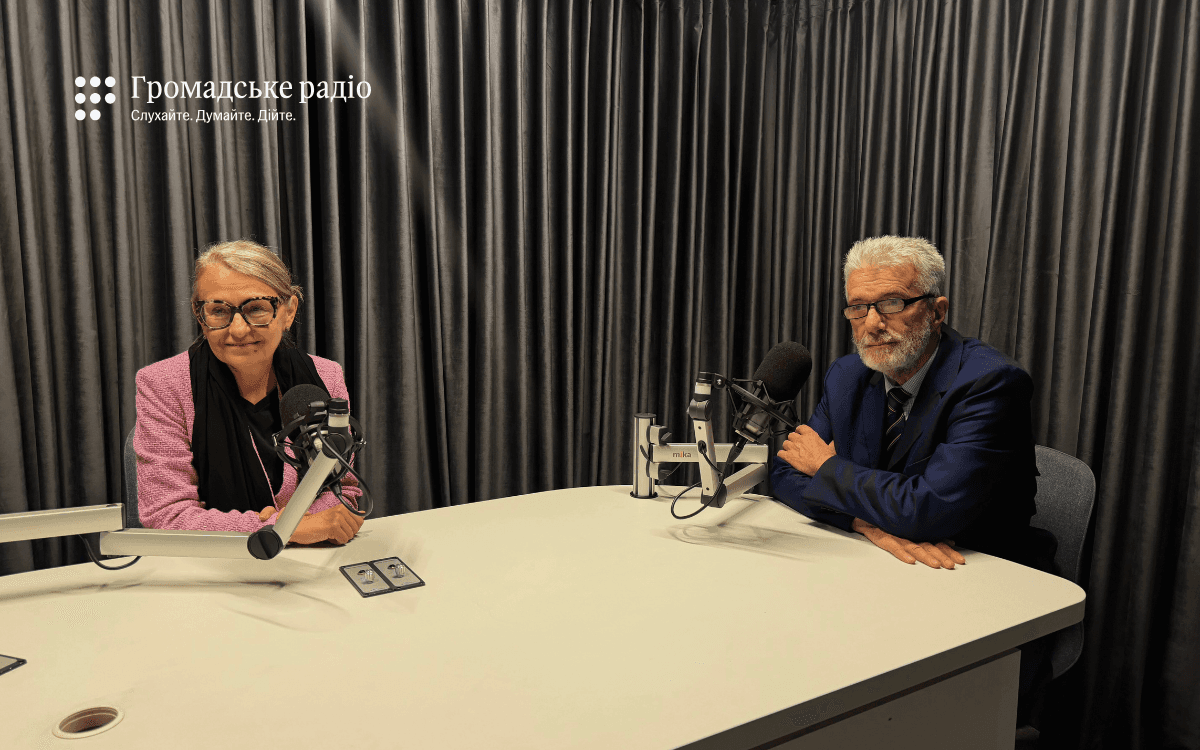 Tiina Intelmann and Andriy Kulykov in the studio of Hromadske Radio
Hromadske Radio spoke with Tiina Intelmann, the Ambassador of Estonia to Ukraine, who began her diplomatic mission in August 2026. Host Andriy Kulykov asked about aid to Ukraine, the friendly relations between the two nations, and the issues that most concern Estonians.
Andriy Kulykov: Your Excellency, I wanted to start with another question, but what I have read today on one of the most popular and serious Ukrainian sites prompts me another question, and it’s about the equipment that Estonian rescuers have given to Ukraine, have donated to Ukrainian colleagues. That’s just one of the examples of everyday help that we receive from the Estonian people.
And my question regarding this is, how much this is the initiative of rank-and-file Estonian citizens, and how much this is the government policy, and where do they meet?
Tiina Intelmann: Well, the grassroots movement that started at the beginning of full-scale invasion has been very strong and continuous. So practically every week we have people who come here voluntarily, and we have gathered funds who are bringing cars or other equipment. But of course, it’s also government policy. And this government policy, of course, is supported by the support of the Estonian people.
And that support is monitored through polls on a continuous basis.
Andriy Kulykov: Now to the question that I wanted to ask, not less than the previous one. When a new ambassador arrives in a country, what is the focus of her or his attention? What she has to do in order to provide for the success of her work?
And have you done everything that you should have done just when you arrived to Ukraine?
Tiina Intelmann: Well, first of all, before arriving, there is a whole process and procedure. There’s a lot of discussions, a lot of heated discussions even, a lot of instructions that are being given, and a lot of meetings that one has to take to figure out what exactly the ambassador should do during his or her tenure. But after arriving, it’s all about human relations and contacts. So I have tried to build these contacts, and I have said that I can say that I am blessed.
I am blessed. People are very open, very friendly. So from this perspective, working in Ukraine has been extremely, extremely pleasant.
Andriy Kulykov: The stereotype is that our national characters are rather different. And when you single out the friendliness of Ukrainians, many Ukrainians would say those who have not contacted Estonians, that Estonians are very reserved. How much truth is there?
Tiina Intelmann: I think there is a certain element of truth.
But at the same time, Estonians are very loyal. So once you build up a relationship, then you can count on loyalty. So that should make things easier.
But of course, foreigners who live in Estonia, they don’t complain about Estonian character. What they do complain about is weather.
Andriy Kulykov: Well, now coming back to the question with which we started. In Ukraine, many, many people do know about the help that we constantly receive from Estonia. But you know, this is the knowledge of general character, like for instance, that Estonia champions the world as far as the share of GDP per capita is concerned, where it is channeled to help Ukraine. But what is seen from Estonia? And I mean, what is the gravest concern of ordinary people? And what is the major concern of the government and political circles in relation to Ukraine?
Tiina Intelmann: Well, in terms of assistance, I should say that the grassroots movement and the grassroots feeling is extremely strong.
And as I also explained, there are polls about that. And the concerns, I think one of the concerns is really that we are not able to do enough. Because Ukrainians are fighting also our war. We have a common threat, common enemy.
So the feeling is very much, and that feeling also I get up every day, and I have the feeling whether I am doing enough, enough, whether I explain enough, whether I am finding the right sources to give assistance. Because you know, one is a long term assistance is called reconstruction.
And there was a long discussion when the war started, when should reconstruction start? We said reconstruction should start from the very beginning. And we chose Zhytomyr region. At some point, the Ukrainian authorities said that it will be useful if every country chose one region and focused on one region.
So we chose Zhytomyr. And we have been doing different projects there. And the idea is now to see what works, what doesn’t work, and to scale.
So that’s what we are doing in terms of long term planning. But also there are ad hoc requests, because it’s war and needs change. So this is why I think that people who are dealing with Ukraine in the capital, and also here in the embassy, we constantly feel inadequate, we constantly feel that we should be doing more.
And we are constantly worried that we are not giving our 120%.
Andriy Kulykov: Some Estonian politicians names and actions are well known in Ukraine, some of them are very notable on the European scale. But taking the country as a whole, how active Estonia is in the European Union and NATO in the efforts to define the policy of these organisations? And to which extent Estonia agrees its policy with Lithuania, Latvia and Nordic countries?
Tiina Intelmann: The European Union, NATO are both about building relations and building alliances.
So within these two organisations, we work very closely with Latvia, Lithuania, but also Nordic neighbours in support of Ukraine. And unfortunately, also both of these organisations are based on consensus. So once you come with a reasonable position, and that position is shared with quite a lot of members, you have a very, very good opportunity to get this position through.
And of course, you know, in terms of NATO membership now, there is no consensus for Ukraine to join NATO. But in terms of the European Union, things are going quite well. And rest assured that Estonia is always on the side of Ukraine, together with the Nordic and Baltic countries.
And sometimes these discussions about how fast Ukraine should move, or how to package the demands, and what exactly the demands are, and what chapters to open, how negotiations should go sometimes, these are not easy discussions.
Andriy Kulykov: You mentioned the common enemy that we have. And this leads me to my next question about the efforts that Estonia applies to build up its defence capacity.
And among other things, when I was in Estonia, I was impressed with the activity of Kaitselit. How active Kaitselit is now, and whether they are changing their role?
Tiina Intelmann: Kaitselit is an organisation that was established in 1918. So it has quite a long tradition.
And the meaning is that every Estonian person should feel that they want to defend their country, and that they’re also capable of defending their country. So in this respect, the fact that the traditional Kaitselit is still active now, and it was re-established in 1991, and is alive and well, I think it’s a very good thing. On the other hand, of course, Estonia, as a state, is also preparing very actively for its defence.
Now, we are planning to allocate 5.4% of GDP to defence next year. Of course, it’s nothing to be compared with Ukraine, because Ukraine is at war. But in terms of peacetime activity, of course, this sum is considerable.
Of course, what we have learned from our history is that you are as strong as your alliances are. So we are actively building these alliances and building the friendships that we have with other European countries and countries across the ocean.
Andriy Kulykov: Ukraine tried to build several alliances of our own, which were not formalised as huge international organisations.
I mean, for instance, the Guam or the Visegrad 4. Is there a kind of an alliance which unites Baltic and Nordic countries, or is it just an ad hoc cooperation?
Tiina Intelmann: Well, some of it is ad hoc, some of it is formalised, and some are also new forms of cooperation, like the JEF, which is directed towards defence, and which also includes the United Kingdom, and which is a response to emerging threats in the Nordic and Baltic region.
But in general, I should say that we are united by common interest. And this is what dictates a lot of the activities and a lot of meetings and decisions that are taken.
Andriy Kulykov: Lately, Vladimir Putin has again stated about the infringement on the rights of the Russian-speaking minorities in Baltic countries. And in relation to this, my question is, how do the Russian-speaking Estonians or Russian-speaking non-Estonians behave in Estonia, especially in Narva and the surrounding area?
Tiina Intelmann: Of course, I cannot speak on behalf of each and every non-Estonian, but I guess that throughout these years that we have been now independent since 1991, the integration process has been quite successful. And of course, besides people applying for Estonian citizenship or not applying for Estonian citizenship or applying for Russian citizenship, we also have polls, for instance, in terms of how people view war in Ukraine.
And I am very glad to say that in terms of non-Estonians, more than half say that they very strongly condemn Russia’s aggression.
People are supporting humanitarian assistance to Ukraine. And people are also saying that they support sanctions, even in case when that raises prices considerably in Estonia.
So, people are actually able or willing to pay from their own pocket in order for sanctions to be applied on Russia so that Russia weakens. So, all of this shows that, of course, everybody is living his or her life. A lot of Russians have relations and relatives across the border.
It’s only natural. Border crossings are open. It may not be as comfortable as it was before, but we are aware of the fact that people want to cross.
So, I hope that everybody is doing well and that life is enjoyable for everybody in Estonia.
Andriy Kulykov: You know, one of the things that you mentioned is a thing that we rarely think about, that, for instance, with the amount of help that Estonia gives to Ukraine, you are bound to feel the aftereffects of this. And in this connection, what are the spheres of life of economy that were most affected by the war that Russia wages against Ukraine, but which cannot but also impact on Estonia?
Tiina Intelmann: Well, in terms of trade and economic cooperation, since Estonia is not such a big country, we had very, very strong ties with Nordic countries.
And the economic, not decline, but relative standstill that has happened in Nordic countries has also had an effect on Estonia. That’s for sure. Be it the building activities or other things, the general health of economies in Nordic countries has a direct effect on us.
Andriy Kulykov: My friend from Vilnius in Lithuania told me a couple of years ago that he could not remember so many, so much Russian spoken on the streets of Lithuanian capital since the break up of the Soviet Union. And he said this started when Ukrainian refugees arrived. What is the situation in Estonia in this relation? But also, what was the biggest problem that tens of thousands of Ukrainians created for Estonia? And on the other hand, what was the gain that Estonia got because they are now with you?
Tiina Intelmann: Ukrainians were granted temporary protection in Estonia. And right now we may have like around 40,000 people. First, of course, you know, the grassroot movement or grassroot feeling was so very sympathetic to Ukrainians. But we were facing the question where to host these people.
And some of the people were hosted on ferries, which I guess created some fears from these Ukrainians as to where these ferries were going to go. But they were not going to go anywhere. They were just standing in Tallinn port because tourism was also very much affected by the situation in Russia and by other situations, and not least also from COVID time.
So at first this happened. And then we started, of course, you know, looking for other premises for Ukrainians. Fortunately, everybody wants to work, which is a great relief.
Everybody wants to be there to work and to be helpful and to earn their own money. So that was something that was very good. Then a big surprise was at a certain point when spring and summertime came when some of these Ukrainians said, but we actually would like to go back to Ukraine, not to stay there because there’s nowhere to stay, but to visit and then to come back to Estonia.
So that created some raising of eyebrows, you know, where are they going if there’s no place to stay? But people want to visit.
Obviously, they have relatives in Ukraine, and they wanted to see what had happened to their houses. So right now, the issue is this temporary protection that is granted and the expectation of the population, I guess, is that people should want to go back to Ukraine, and it would be beneficial for the Ukrainian state if people moved back.
But on the other hand, if there’s nowhere to go back, and if there are no buildings left, if whole towns have been destroyed, how would people then organize their lives? So this is something that we will see in the future.
Andriy Kulykov: What does the embassy know about the Estonian-Ukrainian or Ukrainian-Estonian community in Ukraine? It was rather numerous in Crimea before 2014. There were even a couple of villages where ethnic Estonians were in majority.
What’s the situation now? And do you actually have an opportunity to contact them?
Tiina Intelmann: I have looked into the situation, and according to our calculation, we had like 180 people of Estonian origin. Some of them have left, others have adapted, and I must say that there have been no contacts with the embassy.
Andriy Kulykov: Now the question which I would like to get an answer, probably different from the one that I am going to get, but I may be mistaken.
And it’s about the territories that Estonia lost to Russia after the second Soviet occupation of your country. Something like 2,000 square kilometers.
Tiina Intelmann: Five percent of our territory.
Andriy Kulykov: Not to mention the strategic importance of those areas. How this is remembered in Estonia, whether it is often discussed, and maybe some people demand that Estonia restores its sovereignty over those areas?
Tiina Intelmann: Well, it’s not often discussed, but I don’t exclude that some people may be discussing that more than others. The discussion was very active when we restored our independence, but then there was also the pragmatic side of it, that very few Estonians were left in those territories.
In the southeast, maybe some people of Estonian origin, but mainly none. And whether we wanted to have people who were part of the Russian Federation and who would probably not be loyal to Estonia, that was also one of the considerations. Now, you may also know that we don’t have a formal border treaty with Russia, and this is an instrument of pressure that Russia uses against other countries also, not only against us.
But the de facto border is there. Restoring that five percent, as I said, is not an active discussion. But from time to time, there is a discussion about making the border more pragmatic and more manageable to maybe swapping some of the territories.
But even that discussion has ended nowhere because of our bilateral relationship that is not the warmest, let’s put it this way.
Andriy Kulykov: Well, that’s about the bilateral relations between Estonia and Russia, whereas the bilateral relations between Estonia and Ukraine seem to be very heartful and very strong. But international politics sometimes pays much attention to the formalization of relations.
And in this respect, what is the probability or indeed necessity of concluding, let’s say, a 100-year partnership agreement between Ukraine and Estonia?
Tiina Intelmann: I am not aware of any such proposals. But I would say that we are more considering the possibility of being together with Ukraine in the European Union around the same table on a daily basis, and also in NATO. In terms of a long-term partnership agreement, if such proposal comes on table from Ukrainian side, I’m quite sure that we will look at it and consider.
Andriy Kulykov: And another question, which I ask because you mentioned Zhytomyr region. What was the reason that Estonia opted for, namely, this administrative unit to be chaperoned or helped?
Tiina Intelmann: Well, I think it’s a size. It’s also the fact that Zhytomyr suffered at the beginning of war and needed some assistance.
But at the same time, we thought that it’s kind of for us as a small country, it’s more manageable than some of other regions where military activities were ongoing and where we wouldn’t know how big the needs would be. But of course, right now, we are looking also at, as I said, at scaling the experience that we have received and accumulated in Zhytomyr, and also at other needs, because the war is developing and there are other areas that would also benefit from our assistance. So it’s a developing story.
Andriy Kulykov: A couple of questions, and then we’ll finish. But I’m really interested in what you have told us and in what you are doing. And harking back to the question about what the ambassador has to do first when she or he arrives to a country, apart from contacting people and setting up relations with them, you have to, I suppose, you have to see the country.
I was told by my friends, I’ve only twice been to Estonia, and I would like to go more. But yes, the country is small. And you imagine that it’s more or less similar everywhere you go.
But my friends tell me, no, Tartu is different from Tallinn. Kiuma and Saaremaa is absolutely another story. And all this.
Were you able to travel across Ukraine? And were you able to see something else apart from Kyiv?
Tiina Intelmann: Well, that’s a weak spot. And you spotted the weak spot. I, before coming here, I didn’t know Ukraine, almost at all.
But this is nothing unusual for a diplomat, because a diplomat is sent to different countries. I have been to Odesa. I traveled by car from Odesa to Kyiv.
That’s quite a journey. Which is at least, you know, I have done something. Of course, you know, all of us know the road from Kyiv to Vilnius, to, sorry, Warsaw, to Warsaw, not to Vilnius.
But other than that, there’s still a lot to do. And I will do it.
Andriy Kulykov: What in Kyiv was as you expected? One or two things? And what was totally different from what you expected to find here? Again, one or two things?
Tiina Intelmann: You know, it’s a very strange war.
Because I have been in war zones before. And usually in war zones you expect to feel not very safe, because war is around you. And you don’t know whom to trust or whom not to trust.
Here, it’s a very deceptive situation, because you can walk freely. And you don’t have to be afraid. But then all of a sudden something happens.
So it’s a deceptive situation. And while you feel extremely well, and welcome and comfortable on a daily basis.
Andriy Kulykov: Thank you very much. And I do invite you for other interviews, because I’m sure that allow me to be stereotyped as well, with the insistence and perseverance that is so characteristic of the Estonian people, you will achieve quite a success in the work that you think is necessary here. Thank you.
Tiina Intelmann: Thank you very much for inviting me.